
As “Suggested” We Checked out the RipRap
So once again being proactive we went out to the Skimmer Drive rip rap as suggested by the langan engineers to take look.
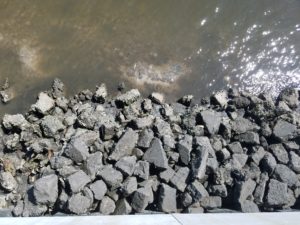 Here is a picture and it is evident the rocks which are only about 2 feet high as originally stacked are sinking into the substrate because it is too soft, and thus pushing out the silt toward the boat lifts. Well they may argue the #57 rock bedding will help that? How? the soil is too soft and the weight of the rip rap will merely push them down as well especially when the weight above it will be at a plus 4 level of rip rap, thus pushing the soil even further out under the boat lifts.
So we also took a look at the test rip rap test site on Pinckney,. This location is up one of the arms of a canal, there is no boating traffic, no heavy waves or rushing tides…..Yet they are rolling down into the canal.
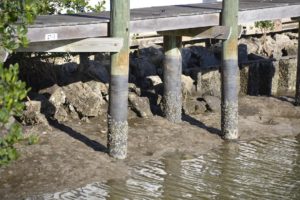
 Here the rocks have sunk down an embedded themselves into the soft sediment underlying the area. This could be checked out further to determine how far down into the sediments a rocks have sunk.
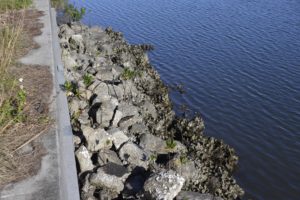
Here is the test site on Pinckney and this is a general view of the 2 feet high rip-rap showing a total of 5 rocks that have fallen off the pile and into the sediments in front of the rip-rap. In this photo, you can see the tops of 3 rocks that have tumbled off the original placement. Note that oysters have colonized these rocks.
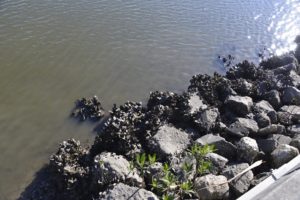
Here you have a good clear view of 3 of the total of 5 rocks that have fallen off original pile. Again, note the oyster colonization.
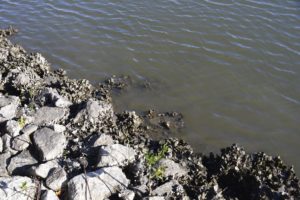
At upper left, you can see one of the rocks from photo showing 3 fallen rocks and the additional rocks that have fallen off the original pile. What looks like 2 rocks photo center is actually one large one. All colonized with oysters.
 This illustrates how far a rock can move from the pile when it is a very low rip-rap pile to begin with (plus 2).
So sloughing has now been shown in the test bed, adding plus 4 to plus 5 (in negative berm) will add so much more weight contributing to a higher degree of sloughing. This is based on a 2-1 ratio as well, but we know the canals are not at 90 degrees, so the steeper the angle of repose the more likelihood of sloughing as proven right here in the test bed of only plus 2 elevation.